Choosing a pita bread line is not a contest to find the biggest number in a catalogue. The right capacity is the output your bakery can sustain, cool, pack and sell while maintaining the bread your customers expect.
For one business, that may mean a compact line producing 750 loaves per hour. For another, it may mean a double-row, triple-row or high-capacity system producing several thousand loaves every hour. The decision should begin with your market, your bread and your daily operating plan, not with the machine alone.
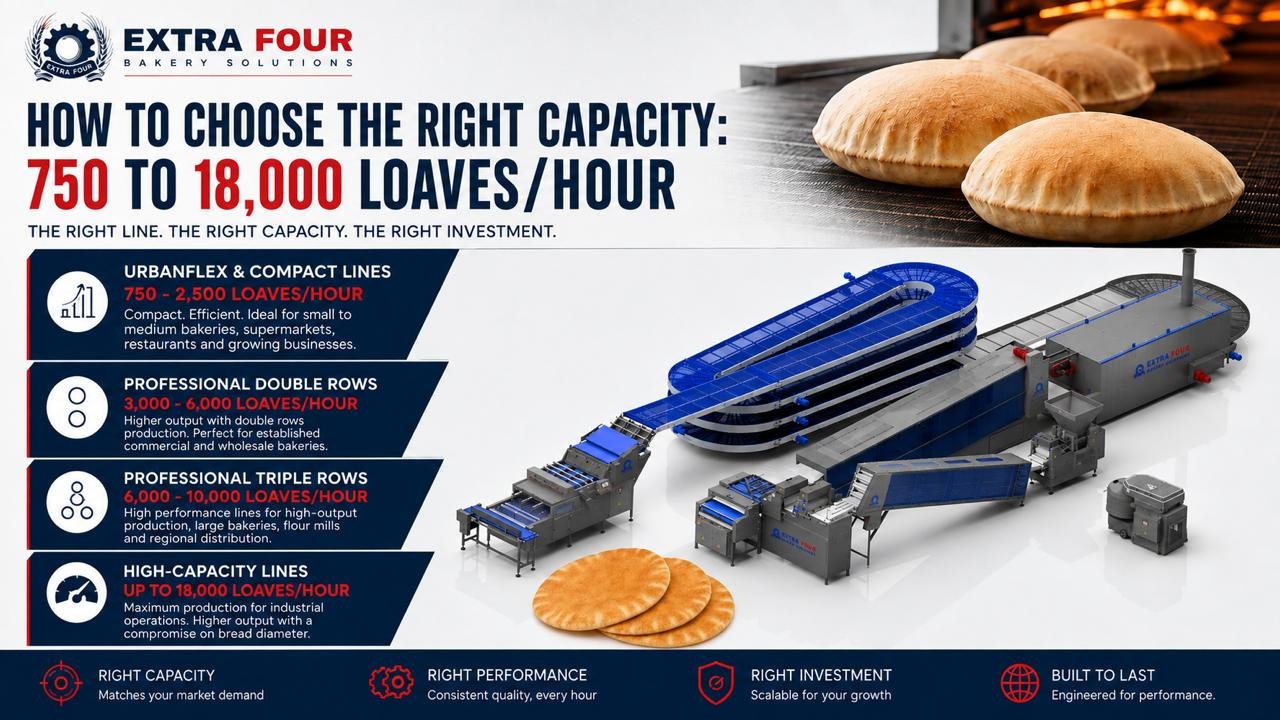
Pita Bread Production Line Capacities at a Glance
- 750-2,500 loaves/hour: UrbanFlex and compact lines for small and medium bakeries, supermarkets, restaurants, central kitchens and growing businesses.
- 3,000-6,000 loaves/hour: Professional double-row lines for established commercial bakeries, wholesalers and regional suppliers.
- 6,000-10,000 loaves/hour: Professional triple-row lines for large bakeries, flour mills, wholesale plants and multi-shift operations.
- Up to 18,000 loaves/hour: High-capacity four-row lines for industrial factories and national or regional distribution networks.
These are planning ranges, not a guarantee for every product. Actual output depends on bread diameter, dough weight, thickness, recipe, proofing and baking time, line configuration, packaging speed and operating conditions. Some compact EXTRA FOUR configurations may also begin below 750 loaves per hour.
Start with the Bread You Need to Sell
A production target only has value when it is connected to real demand. Begin with confirmed sales, regular wholesale orders and realistic growth. Then convert that demand into an hourly requirement.
Required hourly output = daily sellable demand / available production hours
If a bakery needs 30,000 sellable loaves during one eight-hour shift, dividing by eight gives 3,750 loaves per hour. That is only the starting point. Cleaning, changeovers, planned stops and rejected products reduce the amount that reaches the customer.
Planned sellable output = rated hourly capacity x running hours x expected utilization x sellable yield
For example, a 6,000-loaf-per-hour line running for eight hours at an illustrative 85% utilization and 98% sellable yield would produce about 39,984 sellable loaves during the shift, not the theoretical 48,000. Your own operating data should replace those example percentages.
Choosing the Right Capacity Range
750-2,500 Loaves/Hour: Compact Automatic Production
UrbanFlex and compact lines are a practical starting point for bakeries that want repeatable automatic production without committing to a large multi-row installation. They can suit supermarkets, restaurants, hotels, central kitchens, specialty Lebanese or Arabic bakeries and growing wholesale operations.
This range makes sense when floor space, utility demand and operating simplicity matter as much as output. It also gives a business room to improve consistency and reduce manual handling before moving to a wider professional line.
3,000-6,000 Loaves/Hour: Professional Double-Row Production
A professional double-row line is often the next step for an established bakery that has outgrown compact production. Two parallel rows increase throughput while keeping the overall layout more manageable than a wider triple- or four-row system.
These lines are commonly considered by wholesale bakeries, supermarket suppliers and regional distributors. The investment should be supported by sustained orders and a clear plan for cooling, counting, stacking and packaging the additional output.
6,000-10,000 Loaves/Hour: Synchronized Triple-Row Output
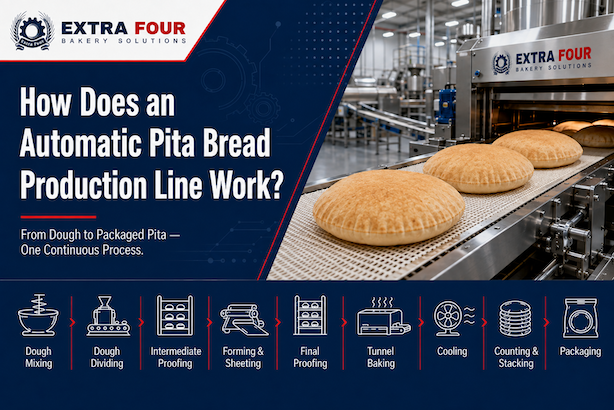
At this level, the complete factory has to behave as one system. Dough dividing, forming, proofing, transfer, tunnel baking, cooling, counting and packaging must work at compatible speeds.
A bakery does not have a 10,000-loaf-per-hour production line if its packaging section can only handle 7,000. The slowest stage sets the sustained output of the whole line. That is why a triple-row project should be evaluated as an integrated production flow, not as a collection of individual machines.
Up to 18,000 Loaves/Hour: Industrial High-Capacity Lines
Four-row high-capacity lines are designed for industrial bakeries where throughput is central to the business model. They may suit large wholesale factories, multi-shift operations and national or regional distribution networks.
There is an important engineering trade-off at the top end of the range: maximum output and maximum bread diameter are not always possible at the same time. Larger loaves occupy more conveyor and oven surface, while smaller diameters allow more pieces to move through a multi-row system.
Can the complete line sustain that output at the diameter, weight, thickness, pocket formation, colour and shelf-life standard our market requires?
Seven Factors That Change Actual Line Capacity
- Bread diameter: Larger pita loaves require more conveyor and oven surface.
- Dough weight and finished thickness: Thin Lebanese bread and thicker pocket pita need different settings.
- Number of rows: More rows increase output only when diameter and spacing fit the belt correctly.
- Proofing time: Higher speed cannot replace proper dough development.
- Tunnel oven performance: Stable heat affects pocket formation, colour and consistency.
- Cooling and packaging: Downstream equipment must match the true output.
- Factory layout and utilities: Space, ventilation, electricity and fuel can change the best configuration.
How to Compare Capacity Claims
When evaluating an automatic pita bread production line, ask for the sustained capacity of every main stage, not only the headline speed of the oven.
Complete-line capacity is the lowest sustainable output among dough processing, proofing, baking, cooling, stacking and packaging.
- Bread diameter, dough weight and finished thickness
- Recipe or flour characteristics that affect processing
- Number of production rows
- Proofing and baking times
- Cooling time and conveyor layout
- Pack count, bag dimensions and packaging speed
- Assumptions for cleaning, stoppages, changeovers and waste
Should You Buy More Capacity Than You Need?
Some headroom is sensible. A line that must run near its maximum from the first day leaves little space for seasonal peaks, a new customer or future growth.
Too much unused capacity, however, can add capital cost, factory footprint, energy demand, maintenance and operating complexity without improving profit.
- Your current confirmed demand
- A realistic next stage of growth
- The peak output required during your busiest shift
What to Prepare Before Requesting a Quotation
- Target loaves per hour and loaves per day
- Bread type
- Bread diameter or diameter range
- Dough weight per piece
- Finished bread thickness
- Working hours and shifts per day
- Factory dimensions and preferred production flow
- Available energy source: diesel, natural gas, LPG or electricity
- Required level of automation
- Pack count, bag dimensions and packaging speed
- Installation country and local requirements
Frequently Asked Questions
What Capacity Pita Bread Production Line Should I Buy?
Choose the line that can sustain your required sellable output at the correct bread diameter, weight, thickness and quality. Allow for realistic downtime and future growth, then confirm that proofing, baking, cooling and packaging can all support the target rate.
Can an Automatic Pita Bread Line Exceed 10,000 Loaves Per Hour?
Yes. EXTRA FOUR high-capacity four-row configurations can reach up to approximately 18,000 loaves per hour. The highest output requires a compatible bread diameter and a complete line designed to sustain the same rate.
Does Bread Diameter Affect Production Capacity?
Yes. Larger loaves use more conveyor and oven surface, which can reduce the number of pieces produced per row and per hour. Maximum output should always be quoted together with the bread diameter.
Which Energy Sources Can Be Used for a Pita Bread Tunnel Oven?
Depending on the project and available utilities, an oven may be configured for diesel, natural gas, LPG or electric heating. The final choice should consider local availability, operating cost, approvals and the required baking profile.
Choose Capacity as a Complete Production System
The right pita bread production line capacity is not simply the biggest output your factory can install. It is the output your team can run reliably, your downstream equipment can handle and your market can absorb.
Planning a new line or expanding an existing bakery? Send EXTRA FOUR your target capacity, bread diameter, dough weight, factory dimensions, installation country and preferred energy source.