Behind every bakery investment is a commitment: savings put into a new business, a family name printed on a bread bag, or a promise to supply customers every morning.
The equipment you choose has to support that commitment. It needs to produce the bread your customers expect, at the volume your business requires, with a team that knows how to operate and maintain it.
That is why choosing a bakery equipment manufacturer deserves more than a comparison of machine specifications and prices. You also need to understand how the manufacturer approaches your project and what happens when you need help after installation.
At EXTRA FOUR, we work with bakery owners planning their first production facility, established businesses expanding capacity, and operators looking to improve the performance of an existing line. Each project starts with understanding the bread, the people making it, and the business behind it.
Start with the Bread You Want Your Customers to Remember
Before discussing machinery, there is a more important conversation: what should your finished product look, feel, and taste like?
Thin Lebanese bread, thick pocket pita, saj bread, tortillas, and European breads each have different production requirements. Dough preparation, forming, proofing, baking, cooling, and handling must work together to achieve the intended result.
Even two bakeries producing the same type of bread may need different equipment configurations. One may supply supermarkets throughout the day; another may produce larger batches for wholesale distribution.
A useful initial discussion should establish:
- The bread types, sizes, and characteristics you want to produce.
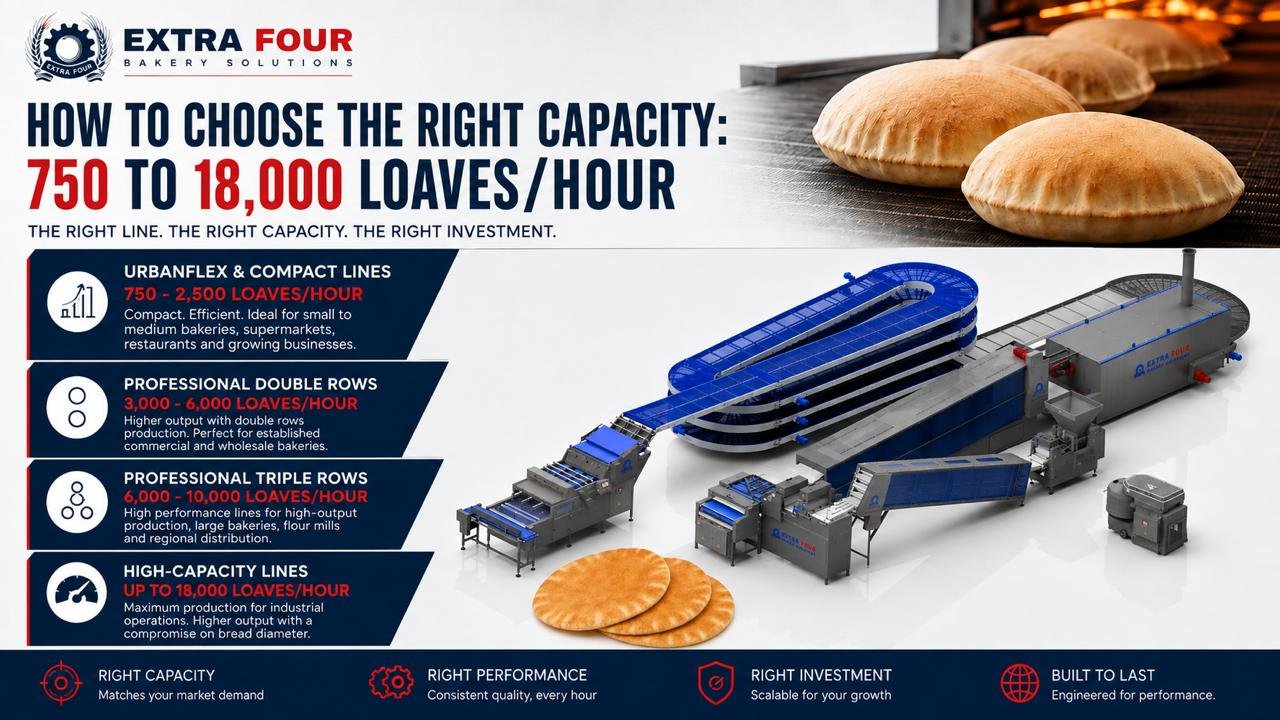
- Your required hourly output and daily production schedule.
- The factory dimensions and available utilities.
- Your staffing, cooling, and packaging requirements.
- Your plans for future growth.
These answers give a manufacturer the information needed to recommend a suitable bakery production line and explain why it fits your operation.
Look for Experience with Your Type of Production
A manufacturer's experience should be relevant to the bread you intend to make.
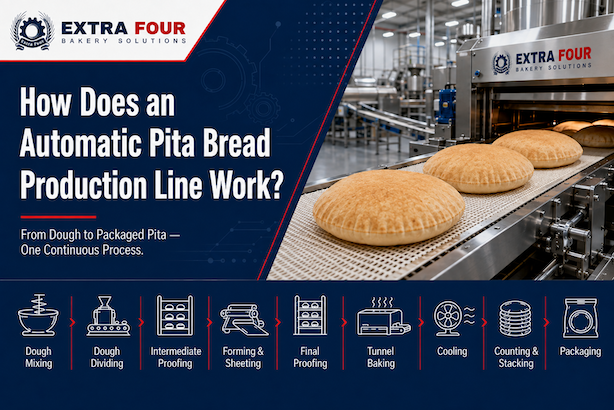
For example, a Lebanese bread production line must manage the delicate handling of thin bread through baking, cooling, counting, and packaging. A pocket pita line has its own requirements for thickness and pocket formation. Pita chips introduce further stages, including cutting, baking or frying, seasoning, and packaging.
Ask the manufacturer to explain the complete process. How will the equipment handle your dough? What determines the production capacity? How will the bread move between machines? What changes when you adjust the product size?
At EXTRA FOUR, our production-line range includes:
- Lebanese and pita bread production lines
- Pocket pita and Greek bread production lines
- European bread and pastry production lines
- Pita chips and crisps production lines
- Saj bread production lines
- Chapati, flatbread, and wraps production lines
- Tortilla production lines
For businesses requiring individual machines, our range also includes equipment for manakish, pizza, pies, kaak, and breadsticks, alongside dough preparation, baking, and handling solutions. Explore our bakery machines.
The right recommendation begins with your production needs, whether that means a complete automated line or one machine that solves a specific problem.
Make Sure the Line Works Inside Your Factory
A production line can look impressive in a quotation and still create difficulties on the factory floor.
Operators need access to controls. Maintenance teams need room to reach service points. Cleaning must be practical. Dough preparation, baking, cooling, and packaging need to connect without unnecessary handling or congestion.
These details affect daily production long after the machinery has been installed.
When evaluating an industrial bakery equipment proposal, ask how the layout accounts for your building, your staff, and the movement of ingredients and finished products. Discuss access, utilities, maintenance clearances, and any space you may need for future expansion.
At EXTRA FOUR, layout and engineering discussions help determine how the individual machines will work together within the available space. The aim is a factory that your team can operate confidently every day.
Ask What Happens After Installation
The first successful production run is an important milestone. The weeks and months that follow are equally important.
A new operator joins the team. A recipe changes. Bread quality becomes inconsistent. A component needs replacing during a busy production period.
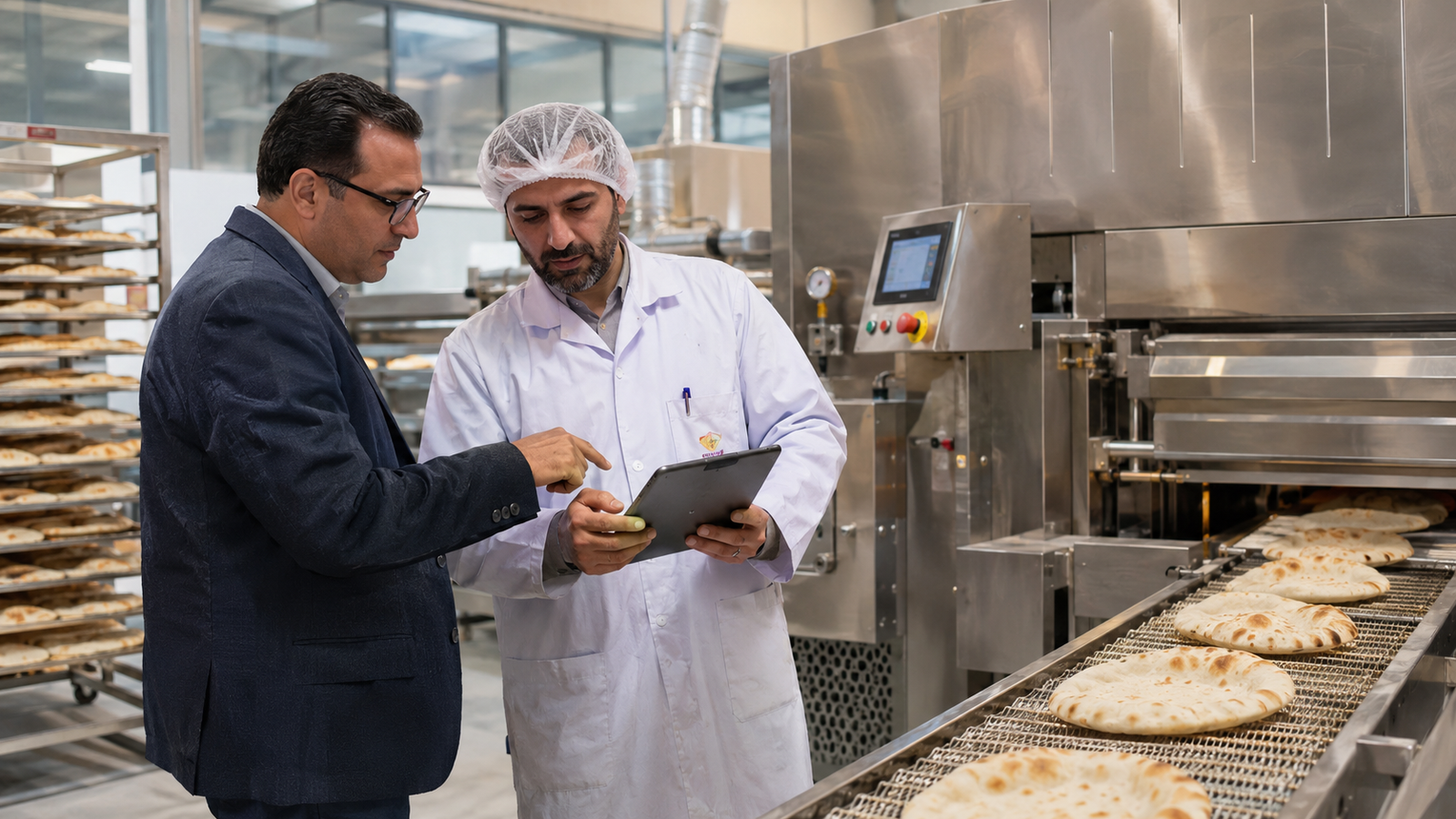
At those moments, you need people who understand both the machinery and the baking process.
Before choosing a manufacturer, discuss:
- Operator training and production guidance.
- Technical assistance and troubleshooting.
- Maintenance requirements and spare-parts support.
- How to request service and what response arrangements apply.
- Which services are included in the offer and which are charged separately.
EXTRA FOUR supports customers through technical assistance, operational know-how, and spare-parts support, with the applicable arrangements defined for each project.
Clear expectations from the beginning help build a relationship that remains useful long after delivery.
You May Need a Bakery Study Before You Need New Machines
Sometimes the most valuable first step is understanding the problem.
If you are planning a new bakery, you may need to establish the production process, equipment requirements, staffing, and operating assumptions before committing to an investment.
If you already operate a bakery, the questions may be different. Why is output below expectations? Why does bread quality vary between shifts? Where are ingredients being wasted? What is causing repeated stoppages?
EXTRA FOUR offers bakery consultancy and technical studies as separately commissioned services, whether or not you purchase equipment from us.
Depending on the agreed scope, a study can examine:
- Production methods and workflow.
- Equipment condition and maintenance practices.
- Bread quality and consistency.
- Production capacity and bottlenecks.
- Ingredient usage and waste.
- Staffing and operating costs.
- Product costing and pricing assumptions.
Findings and recommendations are documented in a report to help owners decide what to address and where to invest.
For a new project, this can help define requirements before construction or purchasing begins. For an existing bakery, it can identify practical improvements to the equipment and processes already in place.
Compare the Cost of Running the Line
The purchase price is easy to compare. The cost of operating a bakery requires a closer look.
Energy consumption, labor, maintenance, spare parts, waste, and downtime all influence the cost of every saleable loaf. A lower initial quotation may offer less value if the proposed line struggles to meet your production requirements.
Ask manufacturers to explain the conditions behind their capacity figures. Discuss your bread size, working hours, staffing, and expected production process so that you are comparing proposals on a meaningful basis.
For an existing operation, improvements may begin with maintenance, workflow, or operating practices. Additional machinery should address a clear production need.
Choose a Manufacturer Who Understands Where You Want to Go
Your bakery will evolve. Demand may increase, customers may request new products, and your team may need to adapt the production process.
A lasting relationship with your manufacturer makes those conversations easier. The team already understands your equipment, your products, and the decisions behind your original installation.
Founded in Lebanon in 1992, EXTRA FOUR designs and manufactures bakery machinery and production lines for customers internationally. Our work combines equipment engineering with practical bakery knowledge, supporting projects from planning and equipment selection through to operational guidance and production improvement.
For us, the conversation begins with a straightforward question: what does your bakery need to achieve?
Frequently Asked Questions
What should I look for in a bakery equipment manufacturer?
Look for experience with your bread type, realistic capacity recommendations, suitable factory layouts, operator training, technical support, and access to spare parts. Evaluate how the proposed equipment will perform under your actual working conditions.
Can EXTRA FOUR assess my bakery without supplying new machines?
Yes. EXTRA FOUR offers bakery assessments and technical studies as separate paid services. The scope, site visits, and deliverables are agreed before the work begins.
What can a bakery technical study cover?
A study can review production capacity, equipment condition, maintenance, bread quality, workflow, ingredient usage, staffing, and operating costs. It may also cover product costing and pricing assumptions, depending on the assignment.
Does EXTRA FOUR supply individual bakery machines?
Yes. Alongside complete production lines, EXTRA FOUR supplies standalone bakery machines and specialized equipment for dough preparation, baking, and product handling.
Let’s Talk About Your Bakery
Whether you are opening a new facility, expanding production, or trying to solve a recurring problem, tell us what you produce and what you want to improve.
We can discuss a complete production line, individual equipment, or a dedicated technical study, with a clear understanding of your priorities before recommending the next step.
Contact EXTRA FOUR to discuss your bakery project.