Producing authentic pita bread consistently at commercial scale requires much more than simply mixing dough and passing it through an oven.
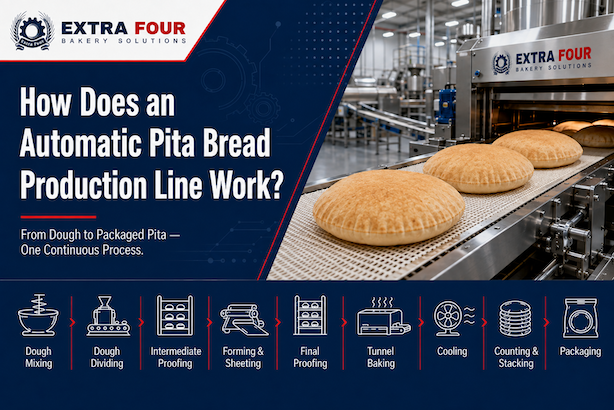
A modern automatic pita bread production line coordinates dough dividing, resting, forming, proofing, baking, cooling, counting, stacking, and packaging into one continuous production process.
Each stage performs a specific function. When all of these stages are correctly engineered and synchronized, a bakery can achieve consistent bread weight, diameter, thickness, pocket formation, color, texture, and production capacity while significantly reducing manual handling.
So, how does an automatic pita bread production line actually work?
This guide follows the complete process from dough preparation to packaged pita bread.
What is an Automatic Pita Bread Production Line?
An automatic pita bread production line is an integrated system of bakery machines designed to convert prepared dough into finished pita bread with minimal manual intervention.
Depending on the configuration, a complete line can include:
Dough mixing, Dough dividing, Intermediate proofing, Dough forming and sheeting, Final proofing, Tunnel baking, Cooling, Counting, Stacking, Automatic bagging.
The objective is not simply to increase production speed.
A properly engineered line controls the dough throughout every stage of production so that thousands of individual pieces can be processed while maintaining consistent bread characteristics.
This becomes increasingly important as production capacity increases.
Step 1: Dough Mixing
Every pita bread production process begins with the dough.
Flour, water, yeast, salt, and other ingredients according to the bakery's recipe are mixed until the required dough development is achieved.
The exact formulation varies considerably between bakeries and markets.
Lebanese pita bread, Arabic bread, pocket pita, whole-wheat pita, and other flatbread varieties may require different:
- Hydration levels
- Mixing times
- Dough temperatures
- Fermentation periods
- Dough consistencies
Consistent dough preparation is essential because every machine downstream depends on receiving dough with predictable characteristics.
Even highly advanced production equipment cannot fully compensate for badly prepared or inconsistent dough.
Step 2: Dough Dividing
After mixing and initial fermentation when required, the dough is transferred to the automatic dough divider.
This is one of the most important machines in the entire pita bread production line.
The divider separates the bulk dough into individual portions according to the required bread weight.
For example, different pita sizes may require different dough-piece weights depending on the desired:
- Bread diameter
- Bread thickness
- Final product weight
- Style of pita
Accurate dividing is critical.
If dough-piece weights fluctuate, the finished bread can also vary in diameter, thickness, baking behavior, and appearance.
A professional automatic dough divider therefore needs to maintain consistent portions while handling the dough gently enough to preserve its structure.
Why Is Dough Dividing So Important?
The dough divider establishes the foundation for every loaf that follows.
Consistent dough weight helps provide:
- Consistent bread size
Each dough piece contains approximately the correct amount of material required for the specified diameter.
- Consistent thickness
Equal dough weights make the forming process easier to control and maintain.
- Reliable baking
Pieces with similar dimensions and thickness react more consistently inside the oven.
- Reduced product giveaway
Overweight dough pieces can translate into significant unnecessary flour consumption over thousands of loaves.
For high-volume bakeries, even small improvements in dividing accuracy can become commercially significant.
Step 3: Intermediate Proofing and Dough Resting
Immediately after dividing, the dough has experienced mechanical stress.
Attempting to flatten it aggressively at this point can cause resistance, shrinkage, or inconsistent shaping.
The dough therefore enters an intermediate proofer.
In many automatic pita bread lines, this consists of multiple conveyor levels that provide sufficient resting time while keeping the equipment footprint relatively compact.
During intermediate proofing, the dough begins to relax.
This allows the gluten structure to become more extensible before the dough enters the forming section.
What Does Intermediate Proofing Do?
Intermediate resting can help improve:
- Dough relaxation
- Forming consistency
- Dough extensibility
- Final diameter control
- Surface quality
- Production stability
The required resting time depends on the dough formulation, production speed, temperature, and bread specifications.
For this reason, proofer design must be matched to the production line's capacity.
Step 4: Dough Forming and Sheeting
After resting, each dough piece must be transformed from a portion of dough into the characteristic round, thin shape required for pita bread.
This is performed through the forming and sheeting section.
Rather than flattening the dough completely in a single aggressive operation, the industrial systems progressively reduce its thickness through several controlled stages.
Gradual forming is important because dough is an elastic material.
Excessive pressure or incorrect roller adjustment can damage the structure of the dough, create irregular shapes, or cause the bread to shrink after forming.
The forming process controls several important characteristics:
- Final bread diameter
- Dough-sheet thickness
- Roundness
- Surface uniformity
- Dough stress
The settings can be adjusted according to the desired bread specification.
Thin Lebanese Pita vs Thick Pocket Pita
Not every type of pita should be processed identically.
Thin Lebanese-style pita requires different forming conditions from thicker pocket pita.
A thicker product generally maintains more dough mass and thickness before baking, while thin pita requires more extensive reduction.
This is why the production line must be engineered around the actual bread the customer intends to produce.
Step 5: Final Proofing
Once the dough has reached its final shape and thickness, it enters the final proofer.
This stage is particularly important for pita production.
The formed dough pieces travel through a controlled resting period before entering the oven.
Multi-level conveyor systems are commonly used because they provide significant proofing time without requiring an excessively long straight conveyor.
During this stage, the dough continues to relax and develop.
Correct final proofing contributes to:
- Uniform bread structure
- Proper oven expansion
- Improved pocket formation
- Better surface quality
- Consistent bread texture
Both under-proofing and excessive proofing can negatively affect the finished bread.
The objective is therefore not simply to provide the longest possible proofing time. The process must provide the correct resting conditions for the dough being produced.
Step 6: Entering the Pita Bread Tunnel Oven
After final proofing, the dough pieces are transferred automatically into the pita bread tunnel oven.
This is where one of the most distinctive transformations in industrial baking occurs.
A flat piece of dough enters the oven.
Seconds later, it can emerge as a fully expanded pita with two distinct layers and an internal pocket.
The process depends on rapid and controlled heat transfer.
Step 7: How Does the Pita Pocket Form?
The pocket inside pita bread is created primarily by steam.
When the thin dough enters the high-temperature baking environment, moisture inside the dough rapidly converts into steam.
As pressure develops between the upper and lower surfaces, the dough layers separate and the bread inflates.
This produces the characteristic pita pocket.
Several variables influence successful pocket formation:
- Dough hydration
- Dough thickness
- Proofing
- Oven temperature
- Heat distribution
- Baking time
- Dough formulation
- Surface condition
The oven therefore needs to deliver intense and balanced heat quickly enough to generate expansion without excessively drying or burning the bread.
Why Does Some Pita Bread Not Puff Correctly?
Poor pocket formation can have several causes.
Examples include:
- Incorrect dough hydration
- Inconsistent thickness
- Insufficient resting
- Excessive resting
- Incorrect baking temperature
- Uneven oven heat
- Damaged dough surface
- Incorrect fermentation
This demonstrates why pita bread quality cannot be attributed solely to the oven.
The entire production line—from dividing through proofing and forming—contributes to what happens inside the baking chamber.
Step 8: Tunnel Baking
During baking, the pita travels continuously through the tunnel oven.
Depending on the equipment configuration, heat may be controlled from both the upper and lower sides of the baking chamber.
The objective is to achieve a rapid, uniform bake while controlling:
- Pocket formation
- Bread color
- Surface finish
- Moisture retention
- Softness
- Final texture
The conveyor speed and heating intensity must work together.
If the baking time is too long, the pita can become dry.
If it is too short or the heat is insufficient, pocket formation and color development may be poor.
A well-designed tunnel oven therefore allows the bakery to control the thermal profile according to its specific product.
Step 9: Bread Exit and Cooling
Fresh pita bread leaves the oven extremely hot.
It cannot normally be placed directly into plastic packaging.
The bread therefore moves onto a cooling conveyor system.
Depending on the required production capacity and available factory space, cooling can be performed using:
- Extended conveyors
- Multi-level conveyors
- Elevator systems
- Integrated cooling arrangements
The objective is to reduce bread temperature gradually while maintaining continuous production flow.
Why Is Cooling Important?
Packaging excessively hot bread can create condensation inside the bag.
This can negatively affect:
- Product quality
- Shelf-life conditions
- Bread texture
- Packaging appearance
Cooling also allows the bread structure to stabilize after baking.
An industrial cooling section must therefore be sized according to the oven capacity, and a main factor of this section is determined by the country & location where the production line is installed. Weather, humidity, and climate affect this process.
A line producing thousands of loaves per hour requires enough cooling capacity to prevent a bottleneck after baking.
Step 10: Flipping, Counting and Stacking
After cooling, pita bread must be organized before packaging.
At lower production capacities, bakery workers may perform this process manually.
At higher capacities, manual counting quickly becomes inefficient.
An automatic counter and stacker can handle the bread continuously.
Depending on the system, the machine can:
- Receive bread from the cooling conveyor
- Orient or flip bread when required
- Count individual loaves
- Create predetermined stacks
- Transfer completed stacks toward packaging
For example, if a bakery sells pita in packages of five or six pieces, the system can prepare consistent bread stacks automatically.
This reduces repetitive manual handling and helps maintain packaging speed.
Step 11: Automatic Packaging
The final stage can be integrated automatic bagging.
Prepared bread stacks enter the packaging machine, where they are inserted into bags according to the selected configuration.
Automatic packaging becomes particularly valuable on high-capacity lines because the packaging section must keep pace with the output of the oven.
A properly integrated line therefore works as one continuous flow:
Dough → Dividing → Resting → Forming → Proofing → Baking → Cooling → Counting → Stacking → Packaging
Every stage must have sufficient capacity to handle the output of the stage before it.
How Is the Entire Pita Production Line Synchronized?
A production line is only as efficient as its slowest section.
For example, installing an oven capable of producing 10,000 loaves per hour provides little benefit if the downstream cooling or stacking system can handle only 6,000.
Professional production-line engineering therefore considers the system as a whole.
Important factors include:
- Conveyor speeds
- Dough resting time
- Oven residence time
- Production lanes
- Transfer timing
- Cooling duration
- Counting capacity
- Packaging speed
EXTRA FOUR modern bakery systems and solutions use sensors, variable-speed drives, PLC controls, and HMI interfaces to synchronize different machines and allow operators to manage production parameters.
How Many Workers Does an Automatic Pita Bread Line Need?
There is no universal answer because labor requirements depend on the level of automation and production configuration.
A line without automatic dough feeding or packaging naturally requires more operators.
A highly automated system may reduce manual intervention considerably by automating the processes.
However, automation does not eliminate the need for trained personnel.
Operators are still required to monitor production, manage dough preparation, adjust process parameters, perform quality control, clean machinery, and maintain the equipment.
The objective of automation is therefore to reduce unnecessary manual handling while improving process consistency.
What Determines the Capacity of a Pita Bread Production Line?
Production capacity is influenced by more than one machine.
Important factors include:
// Number of production lanes
A two- or three-lane system can process multiple dough pieces simultaneously.
// Bread diameter
Larger bread requires more conveyor area.
// Proofing capacity
The proofers must provide enough residence time without restricting production speed.
// Oven width and length
The baking chamber must accommodate the required number of pieces while providing adequate baking time.
// Cooling capacity
Bread needs sufficient time and space to cool before packaging.
// Packaging capacity
The final packaging section must be able to handle the line's finished output.
This is why production capacity should be evaluated for the complete system, not just one individual machine.
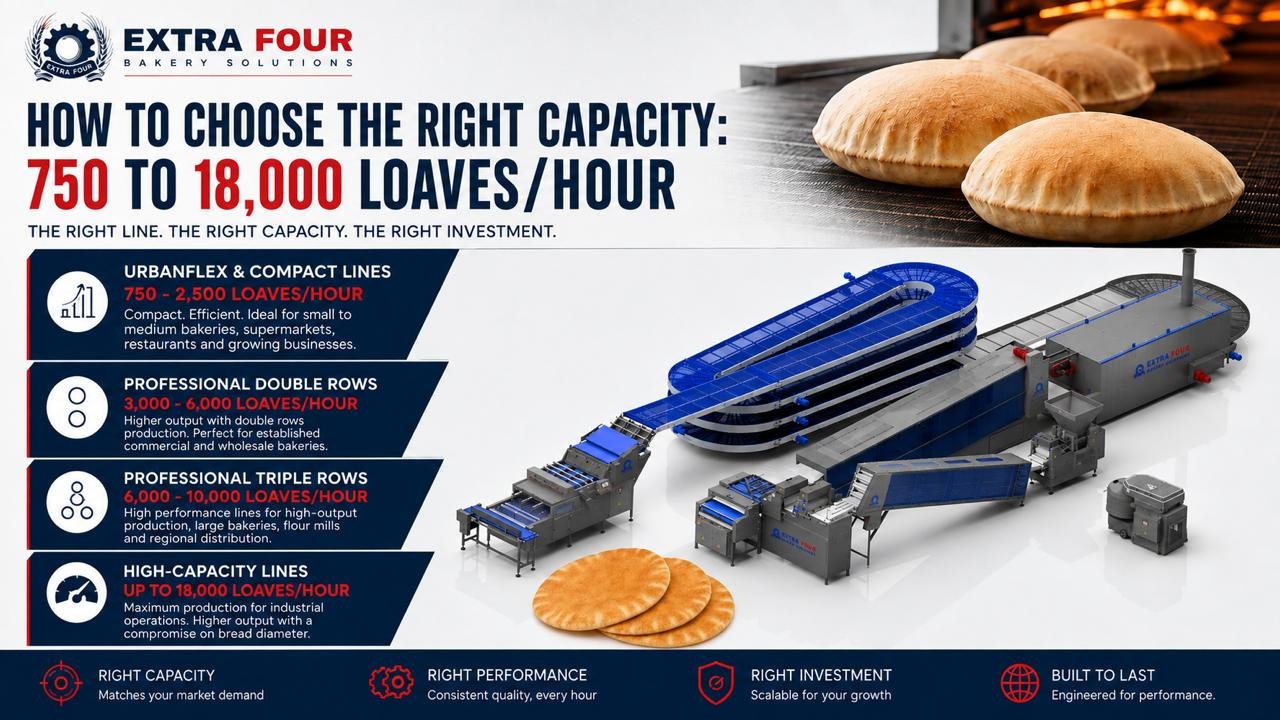
Compact and High-Capacity Pita Bread Lines
Automatic pita production does not always require a massive factory.
Different equipment configurations can serve very different businesses.
Compact pita production lines
Compact systems can be suitable for:
- Supermarkets
- Restaurants
- Central kitchens
- Specialty bakeries
- New bakery businesses
- Facilities with limited space
They prioritize efficient production within a smaller footprint.
Professional and high-capacity pita lines
Larger configurations are suitable for:
- Wholesale bakeries
- Large bread factories
- Flour mills
- Food manufacturers
- Regional distributors
- Multi-shift operations
These lines can incorporate wider machines, multiple production lanes, larger proofers, higher-capacity ovens, extensive cooling systems, and automated packaging.
The best configuration is not necessarily the largest.
It is the one correctly matched to the bakery's market and production requirements.
What Information Is Needed to Design an Automatic Pita Bread Line?
Before selecting equipment, a manufacturer should understand the product and factory requirements.
Important information includes:
1. Bread type
2. Bread diameter
3. Dough weight
4. Desired bread thickness
5. Required production capacity
6. Production hours per day
7. Factory dimensions
8. Available fuel (gas/diesel) supply
9. Available electrical supply
10. Preferred automation level
11. Packaging requirements
12. Installation country
These parameters influence practically every section of the production line.
Why Production-Line Layout Matters
The physical layout of a pita bread line can have a major effect on factory efficiency.
Equipment must be arranged while considering:
- Available floor space
- Production flow
- Operator access
- Cleaning access
- Maintenance access
- Utilities
- Raw-material movement
- Finished-product movement
- Safety zones
Multi-level proofers and cooling conveyors are particularly useful because they allow longer processing times without requiring equally long factory dimensions.
A properly designed layout can therefore provide substantial production capacity while using available space intelligently.
Automation vs Bread Quality
One misconception about industrial bakery equipment is that higher automation necessarily means a more standardized or less authentic product.
That does not have to be the case.
The purpose of properly designed automation is to reproduce the required process consistently.
Bread quality still depends on:
- Flour
- Recipe
- Fermentation
- Dough handling
- Proofing
- Baking
- Process settings
The machinery should support the bakery's product rather than dictate it.
This is particularly important with traditional products such as Lebanese and Arabic pita bread, where customers expect specific characteristics in softness, thickness, color, aroma, and pocket formation.
What Are the Main Advantages of an Automatic Pita Bread Production Line?
Compared with heavily manual production, automation can provide several operational advantages:
- Higher production capacity
- More consistent dough weight
- Better dimensional consistency
- Controlled proofing time
- Repeatable baking conditions
- Reduced manual product handling
- Faster counting and stacking
- Packaging integration
- Improved production monitoring
- Better scalability
The actual economic benefit depends on the bakery's labor costs, production volume, market demand, energy costs, and equipment utilization.
For that reason, an automatic line should be treated as a complete production investment rather than simply a collection of machines.
Frequently Asked Questions About Automatic Pita Bread Production Lines
What machines are needed to make pita bread automatically?
A complete system can include a dough mixer, automatic dough divider, intermediate proofer, forming and sheeting machines, final proofer, tunnel oven, cooling conveyors, counter and stacker, and automatic packaging equipment.
The exact configuration depends on production capacity and automation requirements.
How does an automatic pita bread machine create the pocket?
The pocket forms when moisture inside the thin dough rapidly becomes steam in the oven. The resulting pressure separates the upper and lower dough layers, inflating the bread.
Successful pocket formation depends on dough preparation, forming, proofing, temperature, and baking conditions.
Can one pita bread production line make different bread sizes?
Depending on the equipment design and specified operating range, production parameters can be adjusted for different dough weights, diameters, and thicknesses.
The required product range should always be defined before the equipment is selected.
What is the difference between Lebanese pita and pocket pita production lines?
Thin Lebanese pita and thicker pocket pita have different dough weights, thicknesses, proofing requirements, and baking behavior.
Some equipment can accommodate several products, while other applications may benefit from a line specifically optimized for the intended bread.
Can pita bread packaging be fully automatic?
Yes. Automatic counting, stacking, and bagging equipment can be integrated into the production line, allowing bread to travel from production through packaging with substantially reduced manual handling.
How much can an automatic pita bread line produce?
Production capacities can range from compact systems producing hundreds of loaves per hour to professional multi-lane lines producing many thousands per hour.
Actual capacity depends on bread dimensions, machine width, number of lanes, proofing, baking, cooling, and packaging configuration.
EXTRA FOUR Automatic Pita Bread Production Lines
EXTRA FOUR Bakery Solutions designs and manufactures complete automatic production lines for Lebanese pita bread, Arabic bread, pocket pita, and related flatbread products.
Available configurations can serve compact bakeries as well as professional high-capacity production facilities.
Depending on the project, the production process can integrate:
Dough Mixing → Dough Dividing → Intermediate Proofing → Forming → Final Proofing → Tunnel Baking → Cooling → Counting & Stacking → Automatic Packaging
Each production line is configured according to the customer's bread specifications, desired capacity, available factory space, utilities, automation requirements, and destination standards.
The goal is not simply to automate bread production.
It is to engineer the entire process so that dough moves smoothly from one stage to the next while maintaining the quality and characteristics expected from authentic pita bread.
Planning a new pita bread factory or upgrading an existing production process?
Visit http://www.extrafourco.com or contact EXTRA FOUR Bakery Solutions to discuss your required bread size, capacity, factory layout, and automation level.