Opening a new Lebanese pita bread factory is more than purchasing a production line. It requires the correct combination of market research, bread specifications, production capacity, factory layout, utilities, machinery, workforce, packaging, distribution, and financial planning.
The same principle applies when expanding an existing bakery. Adding capacity without studying the full workflow can create bottlenecks, increase labor requirements, and reduce efficiency rather than improve it.
With more than 35 years of bakery-equipment experience, EXTRA FOUR Bakery Solutions supports customers from the earliest project concept through machine selection, factory planning, installation, commissioning, training, and long-term technical support.
Whether you are planning a compact bakery, a supermarket production unit, a wholesale pita bread operation, or a high-capacity Lebanese bread factory, our team can help you build the project correctly from the ground up.
Why Start a Lebanese or Pita Bread Factory?
Lebanese and Arabic pita bread are established staple products in many markets. They are consumed daily by households, restaurants, hotels, catering companies, supermarkets, schools, and food-service businesses.
A professionally planned automatic pita bread production line can help a bakery achieve:
- Consistent bread weight, diameter, thickness, color, and pocket formation
- Higher production capacity with reduced manual handling
- More stable product quality across every production shift
- Better control of labor, energy use, ingredients, and production costs
- The flexibility to supply retail, wholesale, and food-service customers
- A scalable foundation for adding new bread varieties and capacities
However, success depends on selecting a production solution that matches the actual market. The largest or fastest line is not automatically the best investment. The correct line is the one that produces the required bread, at the required capacity, with a sustainable operating cost and a realistic route to market.
What Should You Study Before Buying a Pita Bread Production Line?
Before selecting any equipment, the entire bakery project should be evaluated as one integrated production system.
1. Define Your Target Market
Start by identifying who will buy your bread.
Your customers may include:
Supermarkets and grocery stores
Restaurants and sandwich businesses
Hotels and catering companies
Local distributors
Wholesale bakery networks
Private-label retail brands
Export markets
Direct-to-consumer bakery outlets
The target market affects the required production capacity, bread size, packaging format, shelf-life expectations, delivery schedule, and level of automation.
A bakery supplying one city has different requirements from a factory distributing nationally or exporting to several countries.
2. Establish the Required Production Capacity
Capacity should be based on realistic sales projections—not ambition alone.
Calculate:
Expected daily demand
Number of operating hours per shift
Number of shifts per day
Planned production days per month
Seasonal demand changes
Expected future growth
Required backup capacity
Planned downtime for cleaning and maintenance
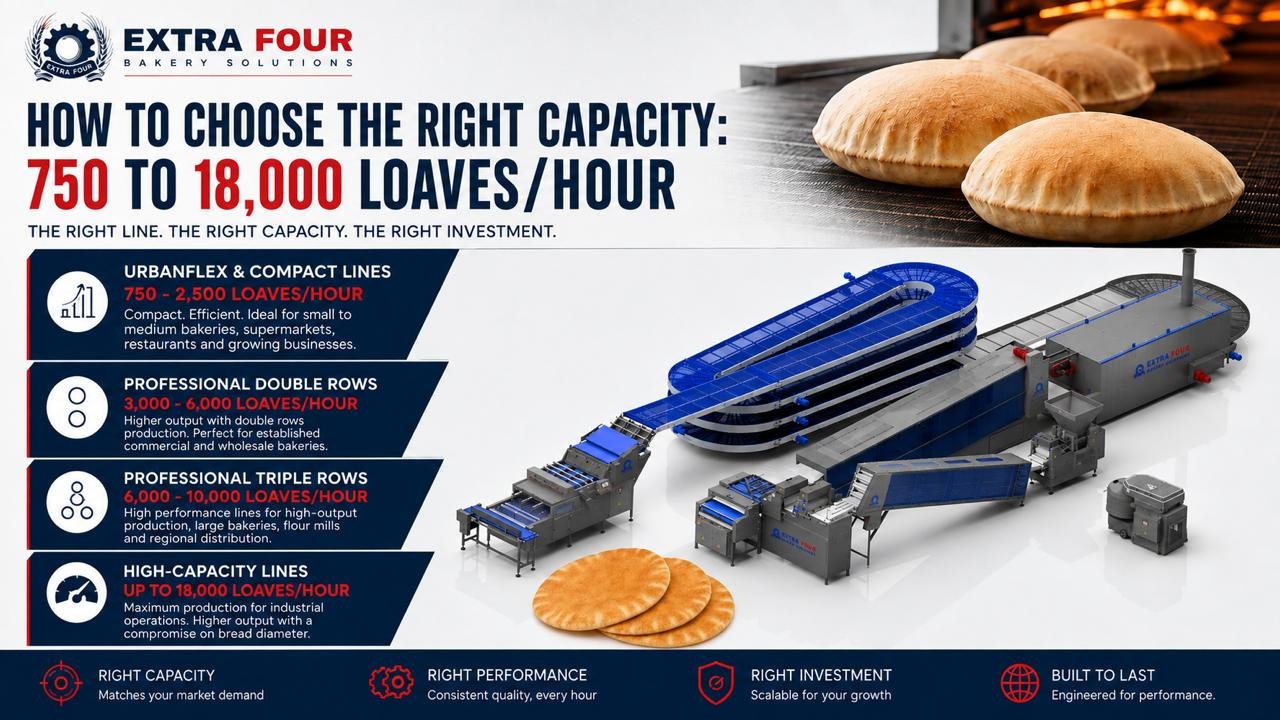
A compact line, "UrbanFlex", may be the right choice for a supermarket, restaurant, neighborhood bakery, or new market-entry project. A high-capacity automated line is better suited to wholesale bakeries, established professional businesses, and large-scale production facilities.
EXTRA FOUR offers different line configurations so customers can select a capacity that supports both present demand and reasonable future expansion.
What Equipment Is Required for a Lebanese Pita Bread Factory?
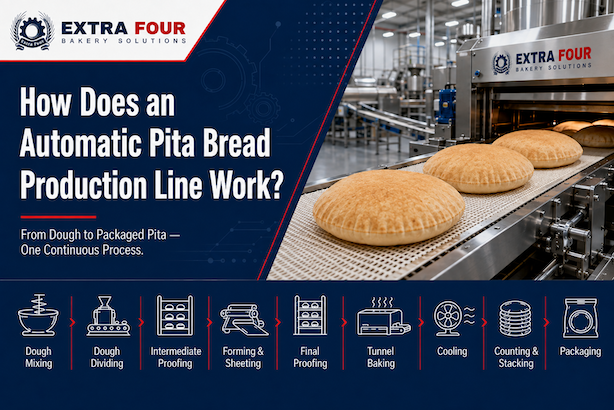
A complete Lebanese bread production line generally includes several coordinated production stages.
Dough Mixing
The mixing system prepares a uniform dough according to the selected recipe, hydration level, batch size, and production capacity. Accurate ingredient and water control are essential for repeatable dough development.
Dough Dividing
The dough divider portions the bulk dough into accurate, consistent pieces. This is one of the most critical stages because variations in dough-piece weight directly affect bread diameter, thickness, proofing behavior, baking, and finished-product consistency.
Intermediate Proofing
After dividing, the dough pieces require controlled resting time. The intermediate proofer allows the dough to relax before final forming and sheeting, supporting smooth processing without excessive stress.
Dough Forming and Sheeting
The dough pieces are progressively flattened and formed to the required diameter and thickness. Proper sheeting must preserve dough structure while creating consistent rounds for the final proofing and baking stages.
Final Proofing
The final proofer provides the controlled resting period required before baking. Correct proofing contributes to elasticity, pocket formation, texture, and consistent oven performance.
Baking
The tunnel oven applies carefully controlled heat to form the pocket and develop the required color, moisture, softness, and surface characteristics.
Oven dimensions, burner arrangement, baking surface, temperature zones, and conveyor speed must be selected according to the bread specification and target capacity.
Cooling
Freshly baked pita bread must cool under controlled conditions before stacking and packaging. An appropriately designed cooling conveyor helps stabilize the bread, manage residual moisture, and reduce the risk of sticking or deformation.
Counting, Stacking, and Packaging
The finished bread can be counted and arranged into predefined stacks before manual or automatic packaging. Packaging requirements should be considered during the original line design—not treated as an afterthought.
Pita Bread Factory Project Checklist
Use this preliminary checklist before committing to machinery or construction.
1. Market and Product Planning:
Define the geographic sales area
Identify retail, wholesale, food-service, and export customers
Select the bread varieties to be produced
Confirm bread diameter, weight, thickness, color, and texture
Determine packaging quantity and format
Estimate daily and future sales volumes
Study competitor products and market pricing
2. Production Planning:
Select the required hourly output
Determine operating shifts and production hours
Decide the required level of automation
Allow for cleaning, maintenance, and product changes
Identify possible future product extensions
Plan ingredient storage and dough preparation capacity
3. Factory and Utility Planning:
Confirm the available building dimensions
Prepare an efficient production-flow layout
Separate raw-material, production, cooling, and packaging zones
Check electrical supply and connected load
Confirm burner fuel type, pressure, and availability
Plan ventilation and exhaust requirements
Verify compressed-air requirements
Plan drainage, sanitation, and cleaning access
Allow sufficient space around every machine for maintenance
4. Commercial and Financial Planning:
Prepare the machinery investment budget
Include freight, installation, commissioning, and training
Calculate raw-material and packaging costs
Estimate labor and utility consumption
Study distribution and transportation costs
Calculate expected production cost per bread package
Estimate sales margins and break-even volume
Develop conservative, realistic, and optimistic ROI scenarios
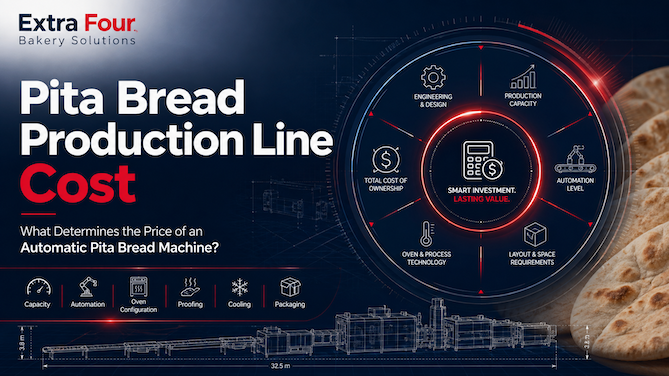
ROI should never be calculated from production capacity alone. A machine may be capable of producing thousands of loaves per hour, but the project’s financial performance depends on utilization, selling price, ingredient cost, labor, energy, packaging, distribution, maintenance, and actual market demand.
Why Choose EXTRA FOUR for Your Pita Bread Factory?
Complete Bakery Project Support
EXTRA FOUR does not approach a new bakery project as a collection of separate machines. We evaluate the production objective, finished product, required capacity, available space, workflow, utilities, automation level, and future expansion plans as one complete system.
Specialized Knowledge of Lebanese and Pita Bread
Lebanese pita bread requires precise coordination between dough preparation, dividing, resting, sheeting, proofing, and baking. Small inconsistencies at one stage can affect pocket formation, shape, thickness, color, or texture later in the process.
Our experience allows us to recommend equipment according to the actual bread required in the customer’s market.
Multiple Capacities and Configurations
We provide solutions for different business models, including:
Supermarkets and retail bakery departments
Small and medium-sized bakeries
Restaurants and centralized kitchens
Wholesale pita bread producers
Professional bakery businesses
High-capacity production facilities
The line can be selected and configured according to the required output, available installation space, product range, and investment plan.
Bakery Project Study and Machine Selection
Our team assists customers in evaluating:
Product specifications
Production capacity
Bread sizes and weights
Line configuration
Factory layout
Equipment efficiency
Labor requirements
Utility requirements
Product flow
Expansion possibilities
Estimated production economics
Project feasibility and potential ROI
These studies support better investment decisions, but all financial projections should be validated using the customer’s actual local costs, sales prices, taxes, financing terms, and market conditions.
Installation, Training, and Technical Support
A successful bakery project does not end when the equipment arrives.
EXTRA FOUR can support the project through:
Line planning and engineering layouts
Equipment manufacturing and preparation
Installation and commissioning
Machine adjustment and testing
Operator and maintenance training
Production startup assistance
Technical follow-up
Bakery spare parts and after-sales support
This full-lifecycle approach helps customers move from project planning to stable commercial production with fewer avoidable mistakes.
Are You Opening or Expanding a Pita Bread Factory?
Whether you are starting from an empty building or expanding an established bakery, the strongest projects begin with the correct questions:
What bread will you produce?
Who will buy it?
How much can you realistically sell?
What capacity do you need?
How much space and labor are available?
What operating cost can the market support?
How should the equipment be arranged for efficient production?
EXTRA FOUR Bakery Solutions will work with you to answer these questions and develop a production solution based on your products, location, market, capacity, and long-term business objectives.
We do not simply supply machines. We help customers create bakery operations designed for consistent quality, efficient production, and sustainable growth.
ENGINEERED FOR PERFORMANCE. BUILT TO LAST.
Website: http://www.extrafourco.com
Email: contact@extrafourco.com
WhatsApp: +961 3 641 804