Investing in an automatic pita bread production line is a major decision for any bakery, food manufacturer, or entrepreneur planning to enter large-scale flatbread production.
One of the first questions buyers usually ask is:
How much does a pita bread production line cost?
There is no single fixed answer.
The price of an automatic pita bread machine or complete production line depends on several technical and operational factors, including production capacity, level of automation, bread specifications, oven configuration, proofing system, cooling system, packaging integration, electrical standards, and installation requirements.
Understanding these factors helps bakery owners compare equipment correctly and choose a production line based on long-term performance rather than simply the lowest initial price.
What Is Included in a Pita Bread Production Line?
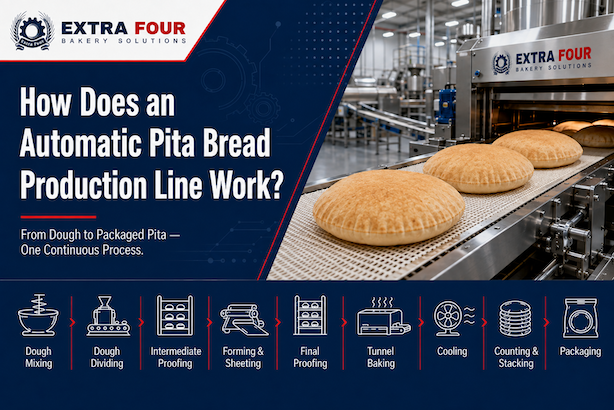
A complete automatic pita bread production line typically consists of several machines working continuously as one integrated system.
Depending on the required configuration, the process may include:
- Dough mixing
- Dough dividing
- Intermediate proofing
- Dough forming and sheeting
- Final proofing
- Baking
- Cooling
- Counting and stacking
- Automatic bagging or packaging
Each stage has an important effect on bread consistency, production speed, labor requirements, and overall product quality.
For this reason, comparing the price of two pita bread lines only makes sense when both systems provide a similar production process and level of automation.
1. Production Capacity
Production capacity is one of the biggest factors affecting the cost of a pita bread production line.
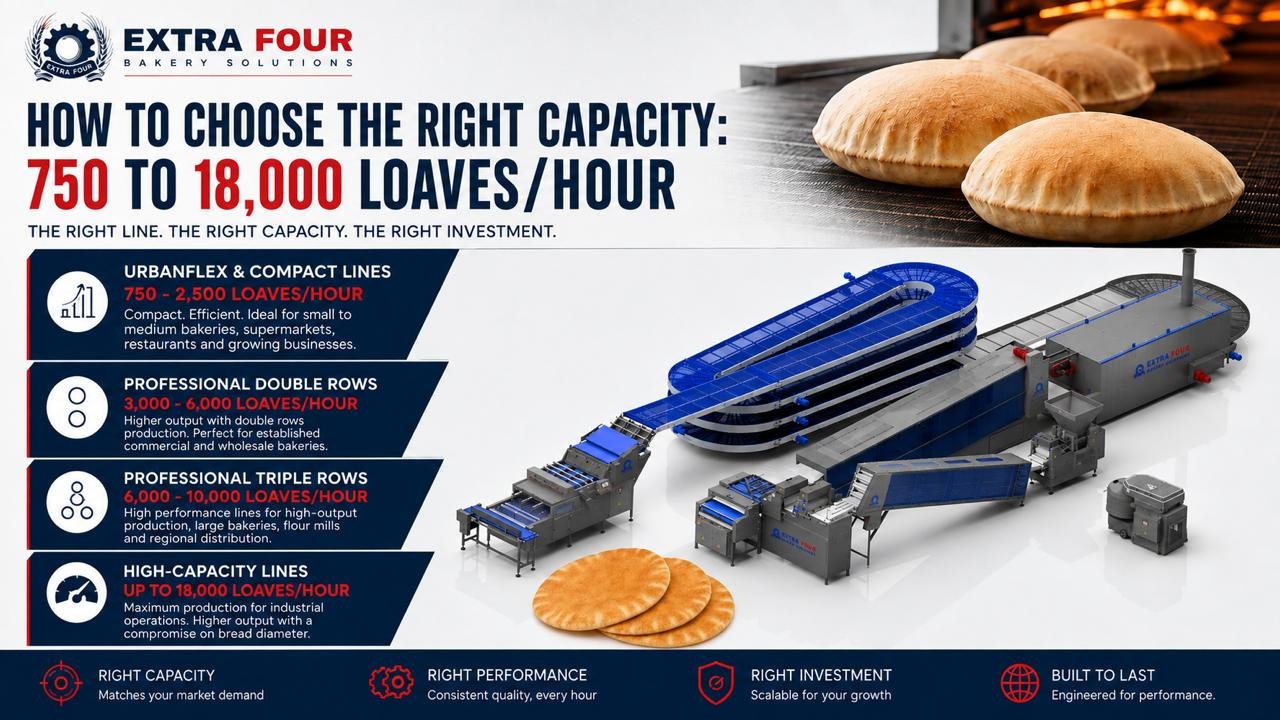
A compact line producing several hundred loaves per hour requires significantly less equipment than a multi-lane production line designed to manufacture thousands of loaves every hour.
Typical applications can range from:
Compact production
For restaurants, supermarkets, central kitchens, specialty bakeries, and smaller commercial operations.
Professional production
For established bakeries requiring higher output and continuous production.
High-capacity production
For industrial bakeries, wholesale bread producers, flour mills, and large food manufacturing facilities.
As capacity increases, the line may require wider conveyors, additional production lanes, larger proofers, larger ovens, more powerful drives, additional controls, and increased cooling capacity.
The correct question is therefore not simply:
“What is the cheapest pita bread machine?”
It is:
“What production capacity gives my bakery the best balance between investment, labor, demand, and future growth?”
2. Number of Production Lanes
Automatic pita bread production lines can be designed with one, two, three, or potentially additional production lanes depending on their configuration.
Increasing the number of lanes allows more dough pieces to move through the production process simultaneously.
This directly affects:
- Hourly production capacity
- Conveyor width
- Proofer dimensions
- Oven width
- Cooling requirements
- Machine footprint
- Electrical load
- Fuel consumption
A single-row compact pita line will naturally have a different investment level from a triple-lane high-capacity production line.
3. Level of Automation
Automation has a major impact on both equipment cost and operating economics.
A basic production line may still require operators to manually transfer, count, stack, or package bread.
A more advanced system can automate nearly the entire process from dough mixing and dividing to finished packaged bread.
Automation may include:
- Mixers with removable bowls and bowl lifters
- Automatic dough dividing
- Multi-level proofing
- Automatic sheeting
- Multi-level final proofing
- Continuous tunnel baking
- Automatic cooling
- Bread flipping
- Electronic counting
- Automatic stacking
- Automatic bagging
- Central HMI control systems
- Sensors and production monitoring
Higher automation usually increases the initial capital investment.
However, it can also reduce repetitive manual labor, improve consistency, minimize handling errors, increase hygiene, and make high-volume production easier to control.
The lowest-priced machine is therefore not necessarily the lowest-cost solution over the lifetime of the bakery.
4. Bread Diameter, Weight and Thickness
Not every pita bread production line produces the same product.
Lebanese pita bread, Arabic bread, thick pocket pita, and other flatbreads can require different forming, proofing, and baking conditions.
Important product variables include:
- Dough weight
- Bread diameter
- Final thickness
- Moisture level
- Dough formulation
- Required pocket formation
- Baking color
- Bread softness
A production line designed for thin Lebanese pita bread can therefore differ substantially from equipment optimized for thicker pocket pita.
The machinery should be selected according to the bread being produced rather than forcing the product to adapt to the machine.
5. Proofing System
Proofing is one of the most important stages in automatic pita bread production.
After dough dividing and forming, the dough needs sufficient resting time to relax and develop the characteristics required for consistent baking.
Professional lines may use multi-layer intermediate and final proofers to provide sufficient resting time while maintaining a relatively compact footprint.
The design of the proofing system influences:
- Dough relaxation
- Gluten development
- Bread consistency
- Pocket formation
- Line footprint
- Overall production capacity
Larger-capacity production lines generally require larger or more advanced proofing systems, which affects total system cost.
6. Pita Bread Tunnel Oven
The oven is one of the most critical components of the entire production line.
Pita bread requires rapid and controlled heat transfer to produce the characteristic separation between the upper and lower layers.
Different oven configurations may include:
- Fuel-fired (Gas or Diesel) tunnel ovens
- Electric tunnel ovens
- Infrared tunnel ovens
- Hybrid tunnel ovens
- Different baking chamber lengths
- Different conveyor widths
- Independent upper and lower heat control
- Different insulation systems
- Different burner or heating-element configurations
The correct oven depends on production capacity, bread specifications, available utilities, local energy costs, and factory requirements.
Choosing an oven based only on initial purchase price can be a costly mistake because energy efficiency and baking consistency affect production every day.
7. Cooling System
Fresh pita bread leaves the oven at a high temperature.
Before counting, stacking, and packaging, it usually needs controlled cooling.
If bread is packaged while excessively hot, condensation can develop inside the bag, potentially affecting shelf life and product quality.
Higher-capacity production lines therefore require sufficiently sized cooling conveyors or multi-level cooling systems capable of matching oven output.
Cooling equipment increases the total production-line investment, but it is an essential part of a complete automatic process.
8. Automatic Counting, Stacking and Packaging
For smaller bakeries, bread may be manually collected and packaged.
At higher production capacities, this rapidly becomes inefficient.
Automatic counting and stacking systems can organize the bread into predetermined quantities before packaging.
A complete line may then feed the bread directly into an automatic bagging system.
Adding this level of automation affects the overall equipment cost but can significantly reduce manual handling at the end of the production process, and most importantly, it is hygiene-friendly.
9. Construction Quality and Components
Two pita bread machines with similar published capacities can have very different construction standards.
Buyers should evaluate:
- Design intelligence
- Stainless-steel construction
- Food-grade conveyor materials
- Bearings and drive systems
- Pneumatic components
- Sensors
- Electrical components
- Safety systems
- Conveyor chains
- Motor quality
- Machine-frame strength
- Accessibility for cleaning and maintenance
- Machine and components durability
Industrial bakery machinery operates for many hours every day.
Small differences in component quality can become significant after years of continuous production.
The real cost of equipment therefore includes not only the purchase price but also maintenance, downtime, spare parts, labor, and expected machine lifespan.
This is where EXTRA FOUR leads the way...
10. Electrical and Safety Standards
The destination country can also influence production-line cost.
A machine being installed in one market may require different electrical components, certifications, fuel systems, safety devices, documentation, or field approvals than equipment installed elsewhere.
For example, installations intended for the United States or Canada may require different electrical and fuel-system considerations than projects supplied to Europe, the Middle East, or Africa.
These requirements should be discussed before manufacturing begins.
11. Installation and Commissioning
A complete pita bread production line is not simply delivered and switched on.
Professional installation usually includes:
- Positioning the machinery
- Mechanical assembly
- Electrical commissioning
- Conveyor alignment
- Oven adjustment
- Production testing
- Recipe calibration
- Operator training
Correct commissioning is particularly important because dough characteristics, flour, water, fermentation, temperature, and bread specifications can vary between bakeries and countries.
A supplier capable of commissioning the line properly can significantly reduce the time required to achieve stable production.
12. Shipping and Factory Location
Transportation costs also depend on:
- Equipment dimensions
- Number of machines
- Shipping destination
- Container requirements
- Local import regulations
- Installation location
A compact production line may fit into fewer shipping containers than a large industrial system.
For international bakery projects, logistics should therefore be considered as part of the total investment.
Pita Bread Machine Price vs Total Cost of Ownership
Professional buyers should look beyond the initial quotation.
The more important calculation is the total cost of ownership.
This includes:
- Initial equipment investment
- Labor requirements
- Energy consumption
- Maintenance
- Spare parts
- Production downtime
- Cleaning time
- Product waste
- Expected equipment lifespan
- Production consistency
A cheaper machine that requires more workers, produces inconsistent bread, or experiences frequent downtime can ultimately cost more than a properly engineered production line.
What Capacity Pita Bread Line Should You Choose?
The correct production capacity depends primarily on your market.
Before selecting a machine, determine:
- Current daily bread sales
- Expected future demand
- Number of production shifts
- Available factory space
- Available operators
- Required bread sizes
- Packaging requirements
- Distribution model
It is usually better to select equipment with reasonable future expansion capacity rather than purchasing a system that will immediately operate at its absolute maximum output.
Compact vs High-Capacity Pita Bread Lines
A compact pita bread line can be ideal for:
- Supermarkets
- Restaurants
- Central kitchens
- Specialty bakeries
- New bakery businesses
- Facilities with limited floor space
Higher-capacity production lines are typically better suited for:
- Wholesale bakeries
- Bread factories
- Flour mills
- Large distribution businesses
- Multi-shift production
- Regional bread suppliers
Neither system is inherently better.
The correct solution depends on the bakery's production requirements.
How Much Does an Automatic Pita Bread Production Line Cost?
Because every project has different production requirements, there is no universal price for an automatic pita bread production line.
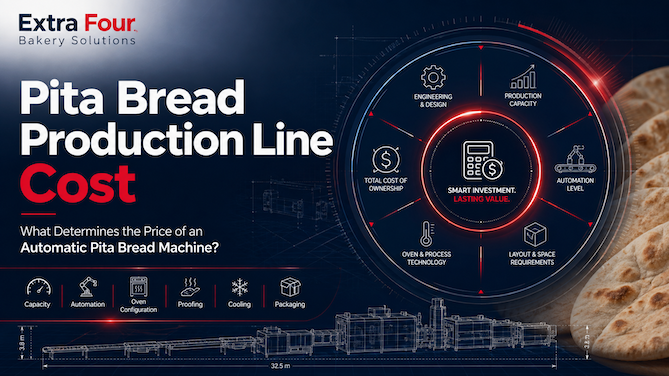
The final investment depends on the following:
Capacity + bread dimensions + automation level + oven configuration + proofing system + cooling system + packaging + destination standards + installation requirements.
For this reason, professional manufacturers normally evaluate the bakery's production requirements before recommending a machine configuration.
Questions to Answer Before Requesting a Quotation
Before contacting EXTRA FOUR, prepare the following information:
- Bread type
- Bread diameter range
- Dough weight
- Final bread thickness
- Required loaves per hour
- Required working hours per day
- Available factory dimensions
- Fuel (Gas or Diesel) or electrical availability
- Required level of automation
- Packaging requirements
- Installation country
Providing these details allows us to recommend a much more accurate production-line configuration.
Choosing the Right Pita Bread Machine Manufacturer
A pita bread production line is a long-term industrial investment.
The manufacturer should therefore be evaluated on more than equipment price.
Look for experience in:
- Pita and Lebanese bread processing
- Dough handling
- Proofing
- Tunnel baking
- Cooling
- Automation
- International installations
- Commissioning
- Operator training
- Spare-parts support
- After-sales technical service
A production line should not simply work during the acceptance test.
It should continue producing reliable bread year after year.
EXTRA FOUR Pita Bread Production Lines
EXTRA FOUR Bakery Solutions designs and manufactures complete production lines for Lebanese pita bread, Arabic bread, pocket pita, and other flatbread applications.
Different configurations are available to accommodate compact bakeries as well as professional high-capacity production facilities.
Depending on the project, a complete line can integrate dough mixing, dough dividing, proofing, forming, baking, cooling, counting, stacking, and packaging into one continuous production process.
Every project is evaluated according to the customer's bread specifications, desired production capacity, available factory space, utilities, level of automation, and local technical requirements.
Rather than selecting equipment based purely on price, the objective is to engineer a production line capable of delivering consistent bread quality, reliable output, efficient operation, and long-term production performance.
Planning a new pita bread factory or upgrading an existing production line?
Visit http://www.extrafourco.com or contact EXTRA FOUR Bakery Solutions to discuss your bread specifications, required production capacity, factory layout, and automation requirements.